
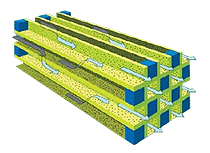
Particulate Reduction Technologies
Particulate filters or Wall-flow Particulate filters remove particulate matter from the exhaust by filtration. They have a honeycomb structure like a catalyst substrate but with the channels blocked at alternate ends, which forces the exhaust gas to flow through the walls between the channels, filtering over 90% of the particulate matter out. The filters are self-cleaning, by one of a number of alternative methods which periodically modify the exhaust gas concentration in order to burn off the trapped particles oxidising them to form CO2 and water.
Particulate filters become clogged by Sulphur, which is present as an impurity in Diesel fuel. It is therefore essential that “sulphur-free” (<10 ppm) Diesel fuel is made widely available to enable this key technology to be fully successful.
Example Vehicles

Honda Civic GX CNG

Opel Zafira CNG
Catalytic Converters (Catalysts)
Three-Way Catalysts a 3-way catalytic converter (“catalyst”) is now standard on every gasoline-engined vehicle. The catalyst uses a ceramic or metallic core (known as a “substrate”) with a coating containing the precious metals, platinum, palladium and rhodium. These metals are the actual “Catalysts” that give the converter its name. They promote the required chemical reactions, but they themselves are not affected by it.
Catalysts need high temperatures to work properly and this initially meant that relatively high emissions were allowed through during the warm-up period. Recent developments have reduced the necessary operating temperature and also made catalysts more robust so that they can be mounted closer to the engine and warm-up more quickly. These “fast light off catalysts” have vastly reduced emissions by cutting warm-up times so that the catalyst can start working within seconds. At the same time catalyst durability has increased, so low emissions are maintained for longer, without replacement.
Three-way catalysts operate in a closed-loop system with sensors to monitor the exhaust gas composition, linked to a computerised engine management system which continuously regulates the air to fuel ratio to maintain the necessary conditions for the catalyst to oxidise CO and HC to CO2 and water (H2O) while reducing NOx to nitrogen (N). For this process to work properly, the mixture of exhaust gases has to be perfectly balanced because the pollutants actually react with each other and with oxygen in the air, to achieve the required result. This perfect balance or “stoichiometric proportions” require a relatively “rich” fuel to air mixture, Diesel engines which use a much lower fuel to air ratio, and modern gasoline engines using “lean burn” technology to improve fuel economy and reduce CO2, need another way to deal with the problem.
Oxidation Catalysts convert CO and HC to CO2 and water and they also reduce the mass of particulate emissions by oxidising some of the hydrocarbons on the carbon particles. They can work with a low fuel to air ratio, but they don’t reduce NOx, so another device, or even a combination of devices, is required in addition.
Example Vehicles

Mercedes Benz E320 BluTec Diesel

Volkswagen Touareg